
⚡ Crypto Total Return Products Are Here
How Liquid Staking Changes Everything


In December, WisdomTree launched the WisdomTree Physical Lido Staked Ether ETP (LIST), the first European ETP backed entirely by liquid staking. The product trades on Deutsche Börse Xetra, SIX Swiss Exchange, Euronext (Amsterdam / Paris), and Borsa Italiana.
LIST represents a first of its kind: a total return staking structured product that enables users to earn full Ethereum staking rewards even while holding an institutional product.
Why Liquid Staking Matters for ETH Products
Lido is a middleware layer that lets users stake ETH and receive a liquid ERC20 token (stETH) representing their staked position plus accruing ETH rewards. The stETH token trades freely on secondary markets (centralized exchanges and DEXs) with significant liquidity.
Ethereum’s validator queues create a structural consideration for fund managers. The entry queue (the wait to begin earning rewards after depositing ETH) fluctuates based on demand. It currently sits at 71 days, with ETH staking demand at an all time high.
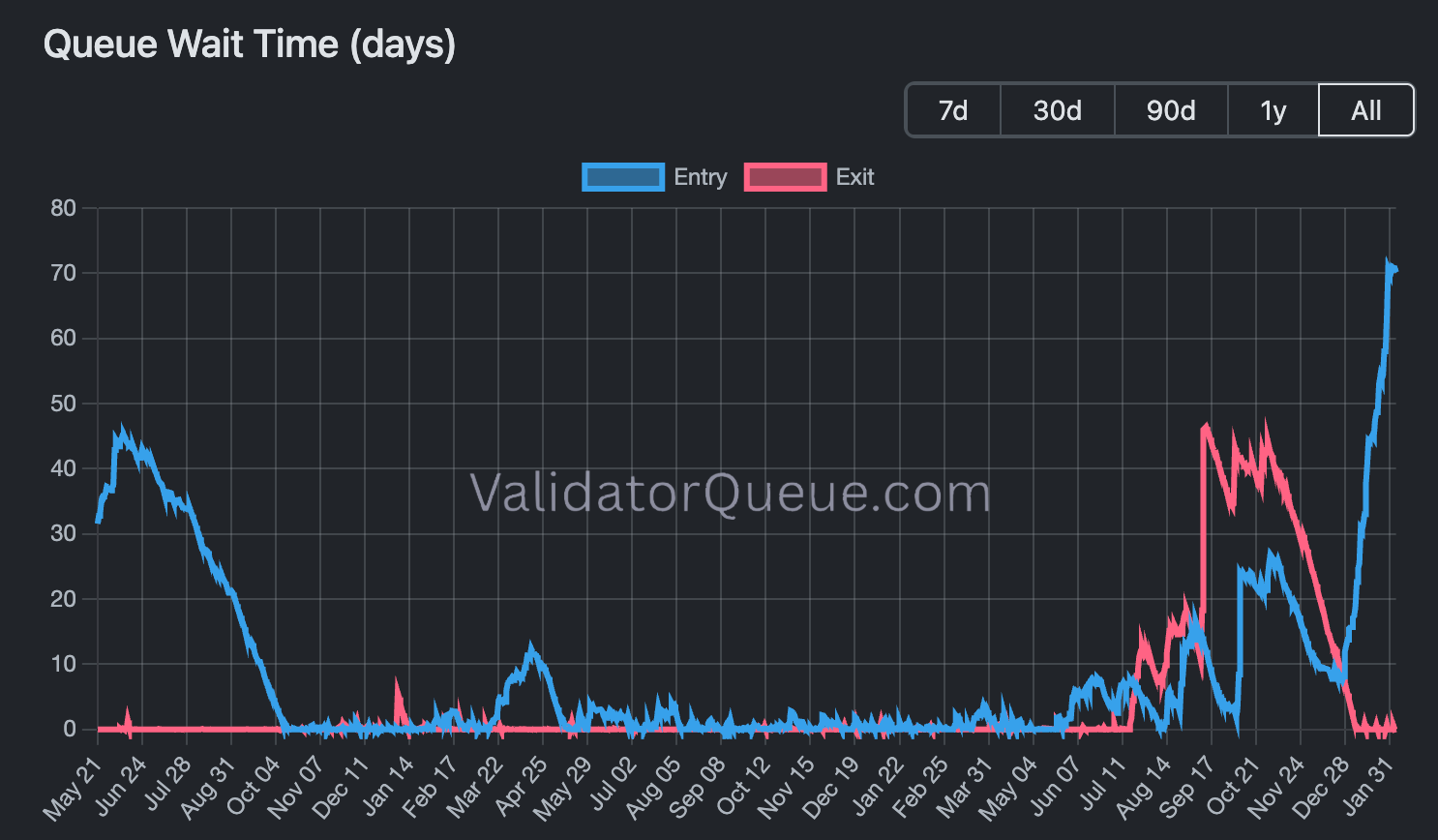
The exit queue to withdraw staked ETH currently sits around 8 hours but has extended to days or weeks in the past during periods of high demand.
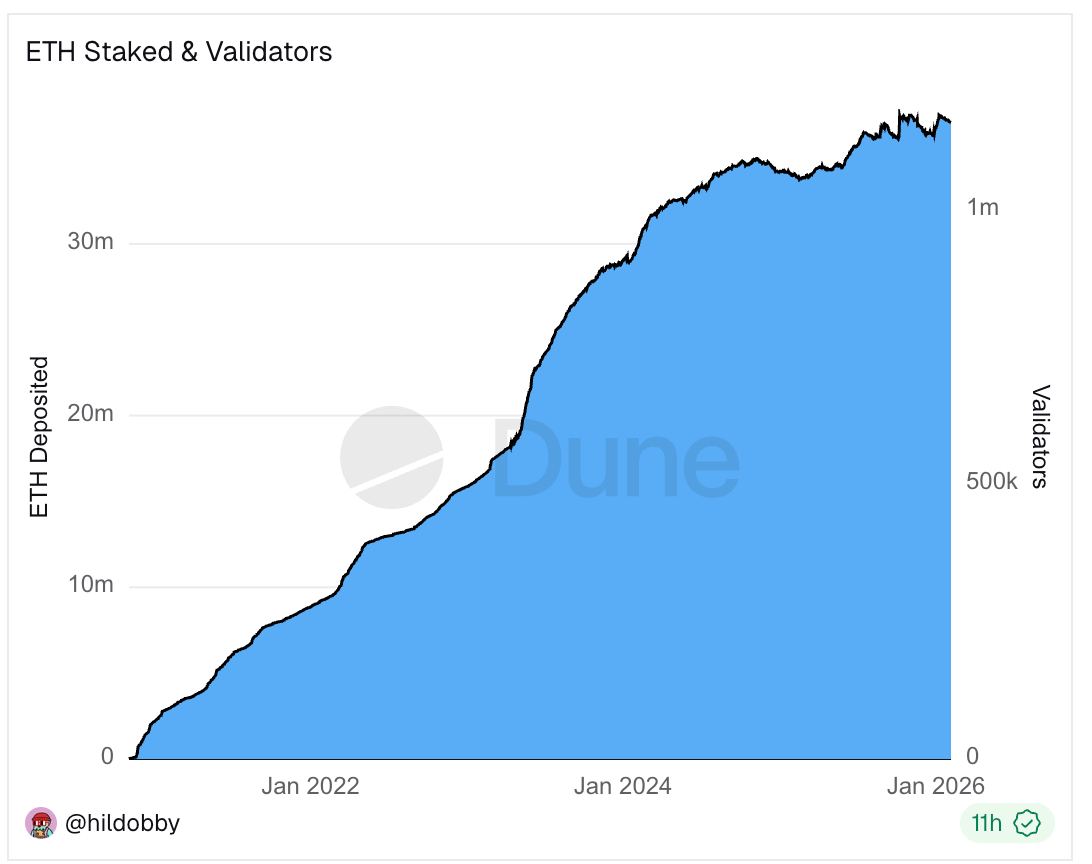
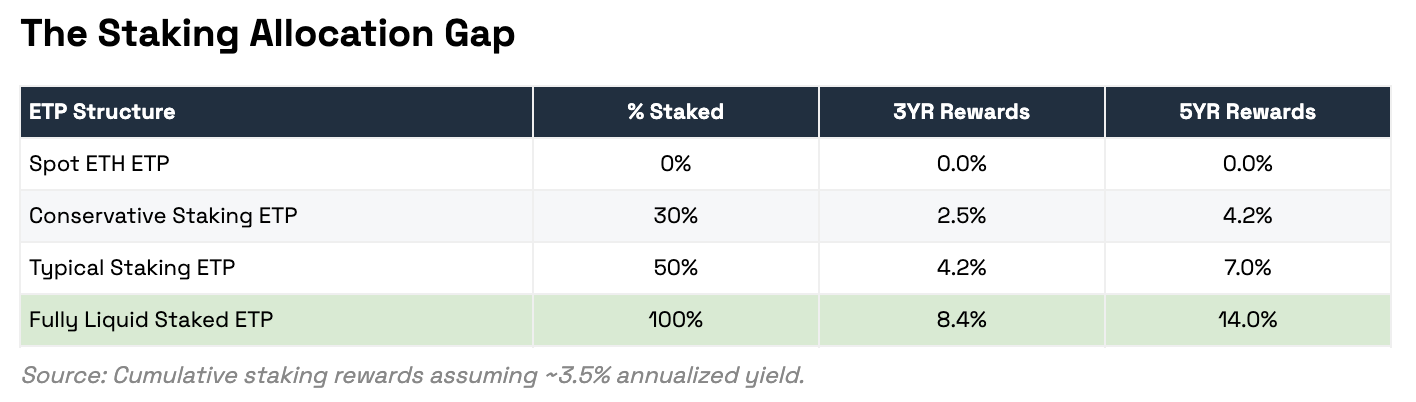
These timelines sit alongside T+1 or T+2 settlement requirements on the asset manager’s side. Most staking ETPs address this by holding 30-50% of assets in spot ETH to process redemptions (often this is enforced by regulators, e.g. Hong Kong has a 30% staking limit). This buffer ensures liquidity but reduces the portion of the fund generating yield for end users.
Liquid staking offers asset managers a solution that helps optimize for both yield and liquidity simultaneously.
The Staking Allocation Gap
Why an ETP Wrapper in the first place?
Institutions are used to holding assets in ETP wrappers. The wrapper abstracts away everything else: custodian onboarding, wallet infrastructure, protocol interactions, node operations, etc. By holding the LIST ETP, instis get access to staked ETH exposure through a structure that already fits into existing workflows, reporting, and compliance frameworks. For a small management fee, the operational complexity disappears.
The Liquid Staking Unlock
An asset manager managing stETH positions can meet redemptions by selling stETH on secondary markets or OTC.
The stETH represents ETH that is actively staking. Buyers on secondary markets step into that staking position instantly, without waiting 71 days for a new validator to activate.
The result: a total return product where 100% of assets generate staking yield, with liquidity managed through market mechanics.
The Operational Case for Liquid Staking
Beyond liquidity, liquid staking dramatically simplifies operations for asset managers while addressing a critical staking risk.
The correlated slashing problem. Ethereum’s slashing penalties scale with correlation. If an isolated validator is slashed, the penalty is modest. But if many validators fail simultaneously due to shared infrastructure, a client bug, or coordinated attack, slashing risks escalate dramatically.
This penalty structure means concentrating stake with the largest operators is usually not the most informed approach. Diversifying across multiple node operators is the primary defense, but creates significant operational overhead.
The DIY traditional staking challenge. Consider an asset manager wanting to stake 1,000 ETH with validator diversification. Custodians typically support a limited number of node operators, so the manager would need relationships with multiple custodians. Each means separate contracts, onboarding, and reporting. Effective risk mitigation requires node operator diversity, multi-client execution, geographic and cloud redundancy, monitoring and alerting, and strong security practices. Once onboarded and staking, the AM’s ops team would manually claim rewards from each validator, restake accrued ETH, and reconcile across providers, often logging into multiple custodian interfaces daily. Building this competency in-house is a full-time operation.
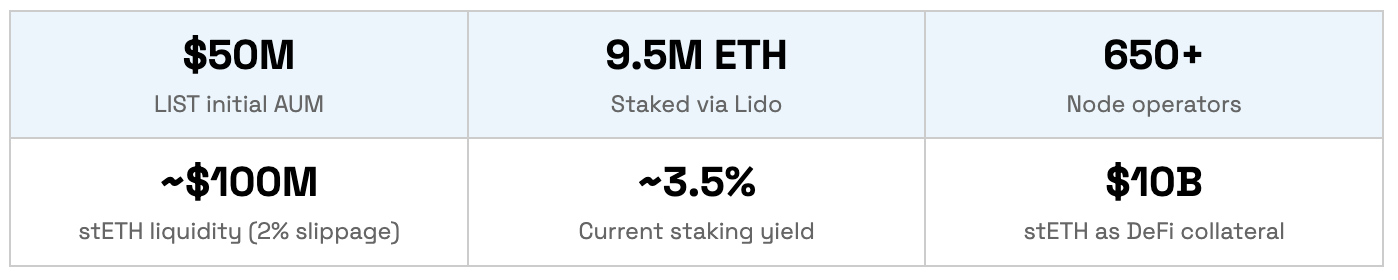
The liquid staking simplification. With stETH, the asset manager holds a single ERC20 token. Rewards accrue automatically and are reflected in the token balance. One custodian, one asset, one reporting line. Lido’s architecture handles the complexity: 650+ node operators and distributed infrastructure. The protocol absorbs the operational burden of managing correlated slashing risk, while the ETP holder simply holds stETH.
Why Lido and stETH?
The viability of this structure depends significantly on secondary market depth. If the token cannot be sold at scale without significant slippage, liquidity concerns remain.
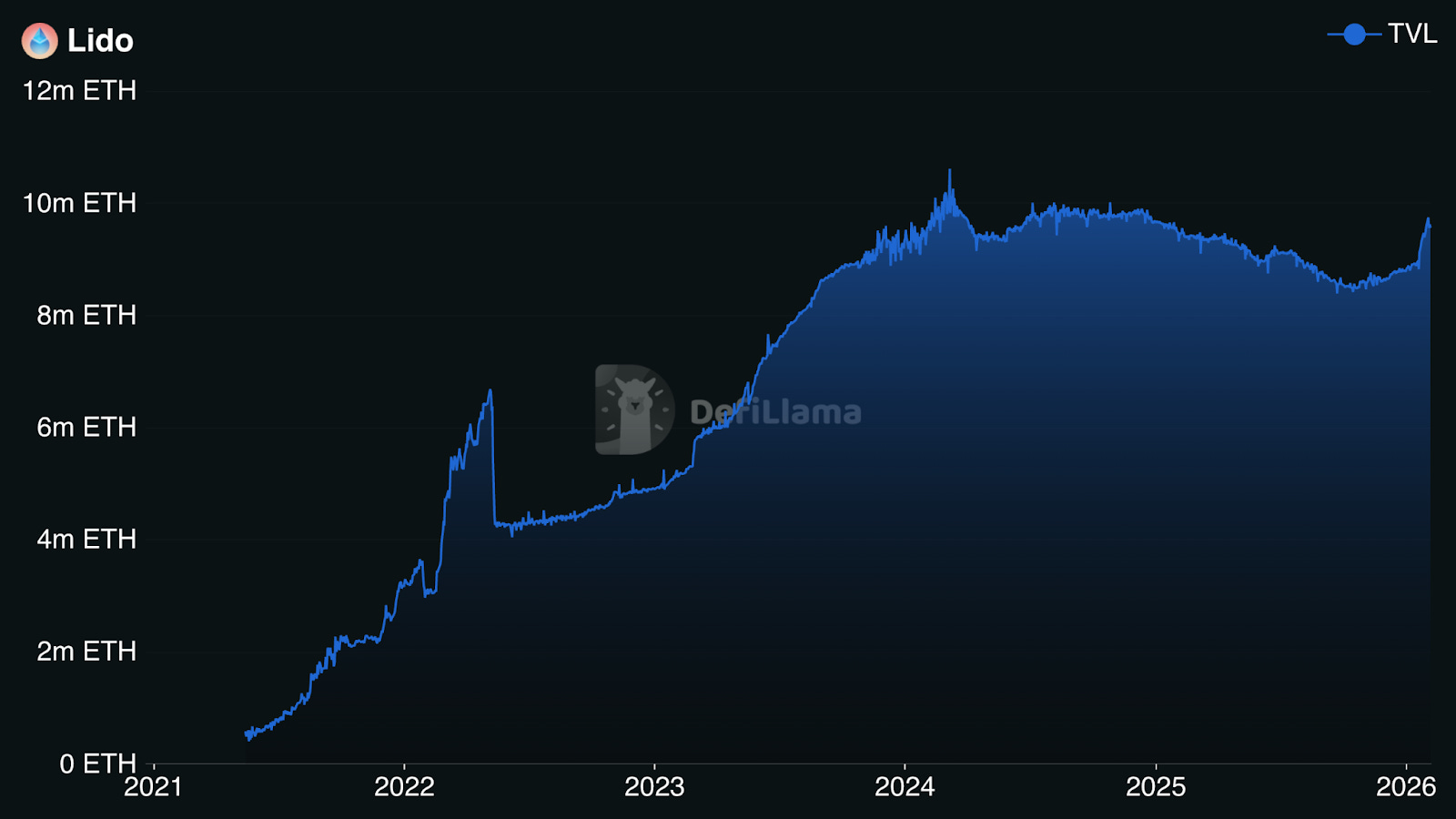
Lido has grown to impressive size and scale over the past years as the default Ethereum LST:
Scale: 23.4% of all staked ETH (8.7M ETH or $19B USD) flows through Lido
Liquidity: $10B deployed as collateral across DeFi; deep order books on centralized venues
Decentralization: 650+ node operators globally, reducing single-point-of-failure risk
Custody: Supported by BitGo, Fireblocks, and other qualified custodians
What This Means for ETF/ETP Issuers
LIST offers a template for asset managers building ETH exposure products. The progression is clear: spot-only, then partial staking, now full staking. Each step captures additional yield.
Europe’s regulatory clarity on physically-backed crypto ETPs made this possible first. The US is following. BlackRock’s amended filing to enable staking in its iShares Ethereum Trust is under SEC review, and approval would accelerate the move toward total return as the baseline for Ethereum ETFs in the US.
WisdomTree is well positioned to lead this shift. The firm manages over $160 billion globally and was the first established asset manager to launch physically-backed crypto ETPs in Europe, building on its heritage in gold and commodity products. Its European business has doubled in the past year to over $50 billion, with crypto and digital assets now representing $770 million in AUM. LIST extends this track record.
From the Key Stakeholders
Until now, most ETH ETPs have kept 30 to 50 per cent of assets unstaked just to manage redemptions. That’s staking rewards left on the table for end investors. Lido’s stETH removes that trade-off - roughly $100 million in secondary market depth within a 2 percent slippage range means liquidity is there when issuers need it. WisdomTree’s launch of a fully staked ETH ETP shows what becomes possible. Every unit of ETH in the fund is working.
Kean Gilbert, Head of Institutional Relations, Lido Ecosystem Foundation
“Staking offers crypto’s most capital efficient yield, secured by design and aligned with protocol health. Institutions that overlook staking are not just missing opportunities. They are leaving money on the table and falling behind.”
Dovile Silenskyte, Director, Digital Assets Research, WisdomTree
By The Numbers
Thanks for reading. Please like and engage with this post and share with just 1 friend!
Want to Reach 8,500 Executives?
Reach institutional decision-makers shaping the future of crypto adoption. Reach out
Staking is the power of investors and staking brings yield